Burning Groove
A review of Ian Herman's new album Glowing Ash Vol 1 & 2.

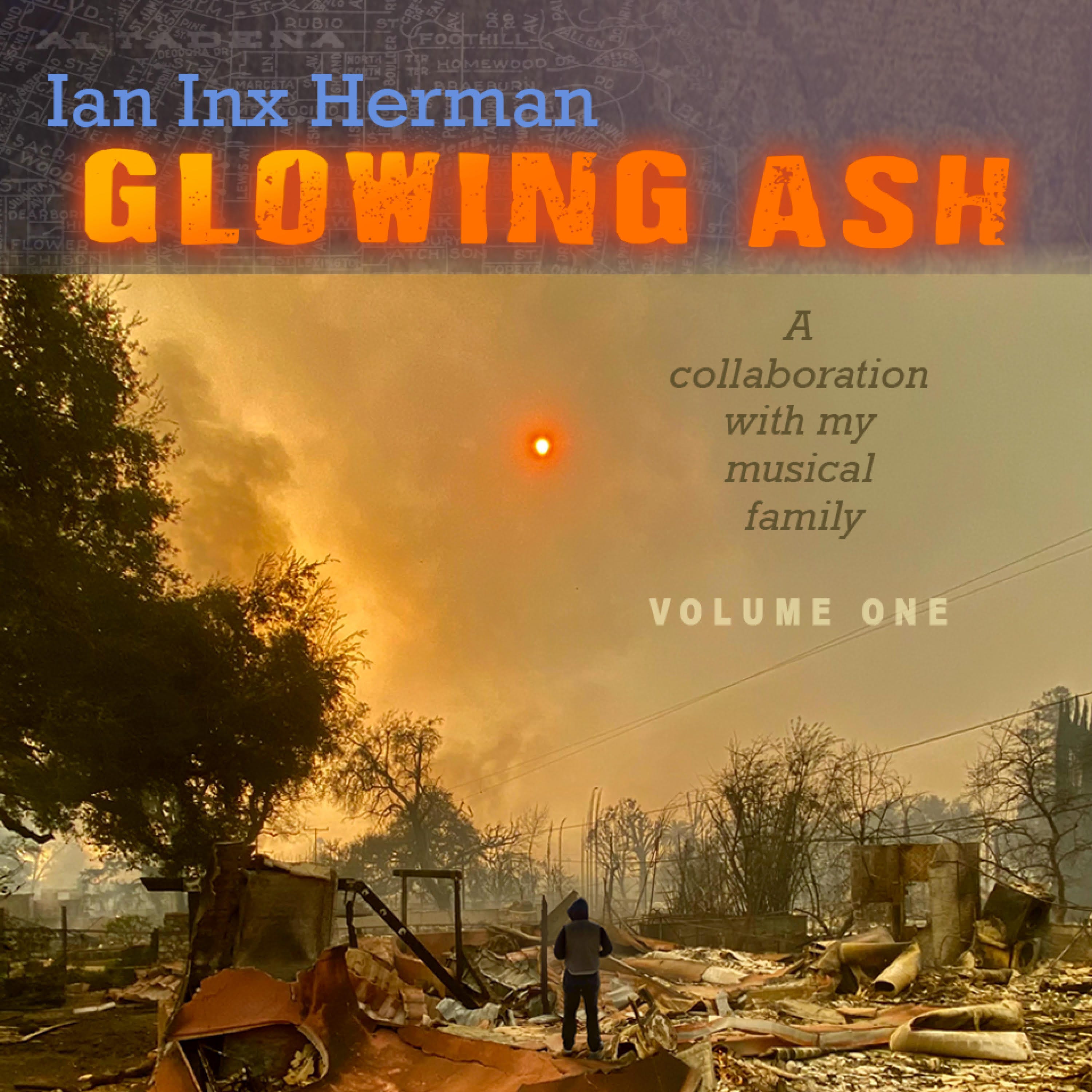
I gagged in the smoke, looking at the burnt bones of my house early that morning. With adrenaline rushing, I felt raw. All the while, the music was pulsing inside of me.
Those were Ian ‘Inx’ Herman’s thoughts as he stood on the piece of land that had contained his house, now burnt to smithereens by the Great Fire. Not just a house, but his home—his entire life—reduced to ash, rubble and smoke. All gone.
It takes a certain type of person to look at that destruction—the still-smouldering detritus of everything you’ve built—and translate it into beats and rhythms that become songs. It takes resolve to turn a tragedy into a victory over the vicissitudes life has chucked your way. Ian Herman did just that, and called the sum total Glowing Ash.
Of course, making the music wasn’t quite so simple. All his drums and instruments were burnt in the fire, so he created rhythms with what was at hand where-ever he stayed—boxes, tins, pots and pans, a metal mailbox on the street, the rim of the toilet seat in his hotel room. He bought or was given a Walmart toy drum kit—that came in handy, too. He sent the beats and rhythms to collaborators, his global musical family. They listened, felt it, worked on it. Riffs, licks, harmonies, more beats and lyrics were added and returned to him as songs.
The result is electrifying. I’ve never heard an album like this—so diverse, so many influences. Afropop follows rap follows jazz follows funk follows… something else entirely. Unclassifiable, even as ‘World Music’, yet so damn groovy. That’s precisely where Ian ‘Inx’ Herman’s special talent hits home: the groove. As a musician, especially a drummer, you either have it or you don’t—and Ian Herman has groove in buckets. So much of it, it’s almost unfair.
It was this inborn talent that made Paul Simon notice him. Simon had been working with a mutual friend, Ray Phiri, preparing for a tour of the Graceland project. One thing led to another, as it does in the music biz, and Ian ended up in New York working with Paul Simon and some of his band members long enough to get a green card before relocating to California. In his 30-odd years in the US, he has worked with Sting, Ernest Ranglin, Manfred Mann, Deepak Ram, and Percy Sledge internationally, and locally with Abdullah Ibrahim, Noise Khanyile, Vusi Mahlasela, Thandi Klaassen, Miriam Makeba.
Like so many other disenfranchised musicians during the apartheid years, his beginnings were humble. He started off playing in a church band, which was often the only place in a community that could afford instruments. Within a few years he joined up with Roger Lucey’s Zub Zub Marauders, but the first time I saw Ian Herman behind a drum kit was at Jameson’s Bar—Jo’burg’s infamous live music venue and den of iniquity at the arse-end of Commissioner Street.
He had just left The Rockets, heard about this new Cape Town band looking for a drummer, auditioned, and got the job on the spot. The band was The Genuines, and they were something else. Wayward sons of the Cape Flats with roots in ghoema, langarm, and Cape jazz, Hilton Schilder and Mac McKenzie, the duo at the centre of the band, could not have wished for a better suited drummer. Until then, they’d been using a drum machine to provide the rhythmic spine of their wild, chaotic, super-fast, bad-arsed crossover of ghoema and heavy rock. But that was about to change.
“We had one rehearsal, broe,” Hilton told me in a recent interview. “One! We kicked all eight songs. Ian was the only ou that could take on that drum machine, know what I mean?”
Herman’s ability to find beats and riddims in songs others could only dream about was as clear as the thwack of wood on vellum. 1986 was the year he popped out of the woodwork, and The Genuines was the band that launched his career. Lloyd Ross saw his potential, and Ian became the Shifty Records house drummer, playing on the records of a vast array of artists—from Isja to Mzwakhe Mbuli to Jennifer Ferguson to Koos Kombuis. Rock, jazz, ghoema, folk, mbaqanga—he could do it all.
This versatility reached a local pinnacle when he teamed up with guitar maestro Steve Newman and Mozambican bassist Gito Baloi. Tananas was one of the most remarkable South African bands ever. The combined skill of the musicians was legendary, and the music they produced was astonishing—fusing ghoema, mbaqanga and jazz into new forms and shapes every time they jammed. Perhaps because they each had full slates of performances and recordings elsewhere, they only came together a few months each year, which meant egos never really entered the room. Absence, as we know, makes the heart grow fonder—and that’s true for music too. “It was the best thing I ever did,” Steve Newman told me.
I was chatting with jazz photographer Rafs Mayet a few days ago, and the conversation turned to band names—and Tananas. I always wondered where the word came from. “Well, it wasn’t because it rhymed with ‘bananas’, bra,” he said, kindly. “Tananas is Durban slang for…” He made a slashing motion near his head. “Deurmekaar, like—all jizzed up, lekker tananas, see?”
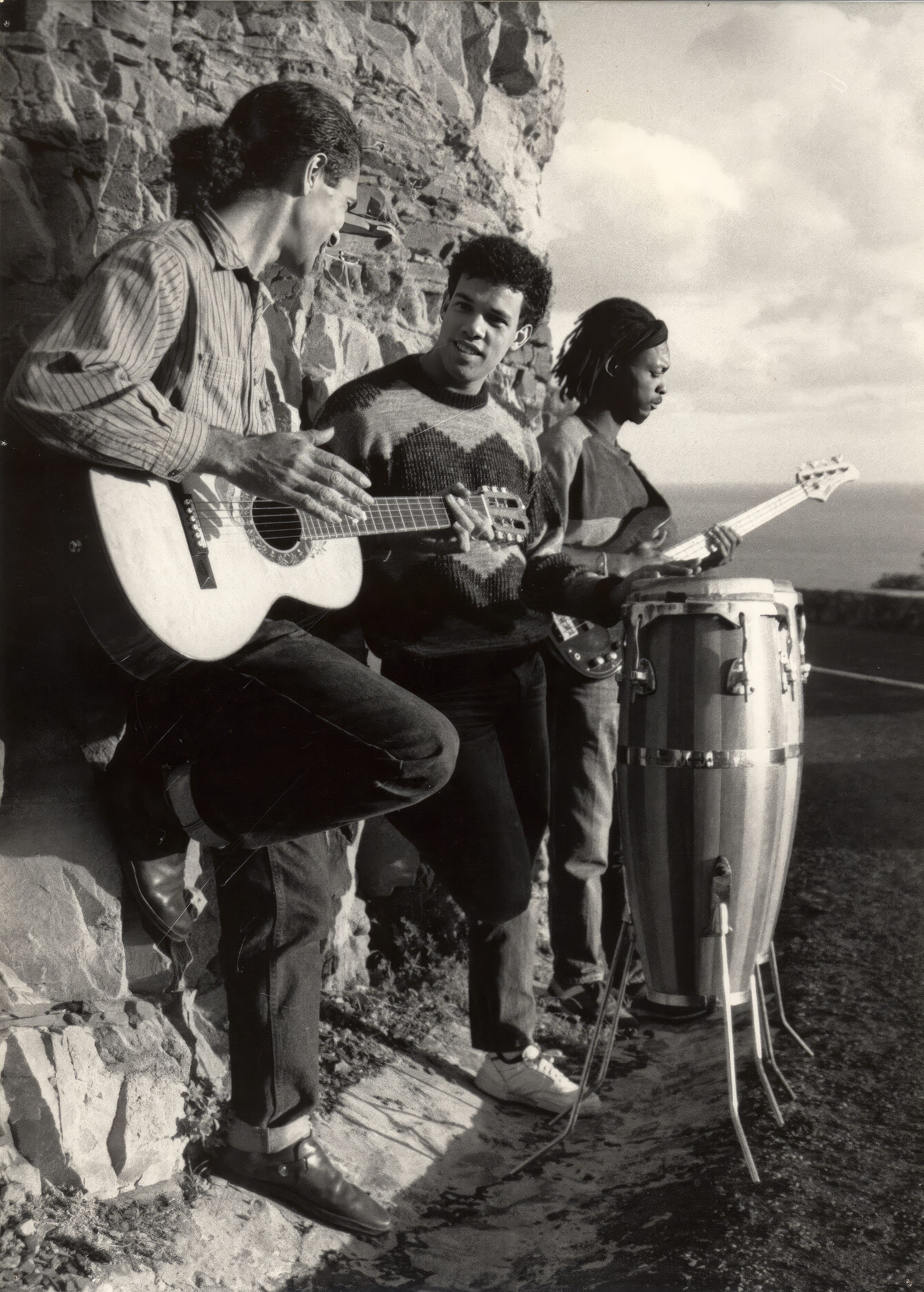
Tananas L-R Steve Newman, Ian Herman, Gito Baloi (Photo: Lloyd Ross)
It made sense. If ever there was a genre-buster, it was Tananas—true to their name, they produced a real mixed grill of sound, a deurmekaar crossover of whatever was on hand in the rehearsal room that day.
Listening to the songs on both volumes of Glowing Ash, the influence of Tananas has unmistakably lingered—despite the contemporary feel and the large number of varied contributors (around forty, according to the liner notes).
While the theme of the album is clearly the fire, the music doesn’t dwell on loss for too long. Each song is a collab between musicians often on opposite sides of the world. From the first plucks of Mongezi Ntaka’s guitar on the opening song “Smoke in the Air,” you know exactly where its coming from—even before the contemplative walking pace of Victor Masondo’s bass wanders in through the Valley of a Thousand Hills, and Vusi Mahlasela’s soaring voice groans: “Fire has no shadow, fire, fire, fire!” Maskandi à la Graceland, dished up hot and smoking in Altadena.
“The fire that destroyed my home was the Eaton Canyon Fire,” Ian WhatsApped me when I asked. “I was living in Altadena, in Los Angeles County, on the foothills of the San Gabriel Mountains. The Santa Ana winds which blow through there are an infamously powerful phenomenon, shrouded in mystique and California folklore. It didn’t start the fire—but it intensified it by a hundred percent.”
Fire, burning deep down in my soul, murmurs Crystal Monee Hall on the follow-up track, “Mar Vista.” Vusi’s Zululand is gone—replaced by the hard beats of a Southern, deep-fried soulful lament: One thing I know for certain, two things I know for sure: the sun goin’ to rise in the morning and that ol’ devil wind gonna blow. She’s talking about the Santa Ana wind like she knows it intimately—and no one’s going to argue, least of all the man who lost his home to it and is now laying down that back-beated, funky groove.
Song after song follows—each from a different part of the world, and each more remarkable than the one before. “US Mailbox” saw its birth months before, in January, with Ian, grinning madly, slapping rhythms out of a postbox like a crazed postman, the street behind him half-obscured by smoke. From there it travelled to Paris via Côte d’Ivoire and Mali, thanks to the voice of Dobet Gnahoré and the bluesy guitar-pickings of Habib Koité, with a detour to Washington, where Mongezi Ntaka now lives, before coming full circle back to L.A.
Volume 2 is no different—though it feels more synth-driven. Like Volume 1, it opens with a Vusi Mahlasela number—the rousing “Drums on Fire”—followed by some ultra-groovy, synth-heavy tracks variously produced and mixed by JB Arthur, Alan Hertz, and Frank Swart. It features a host of musicians we might not know down here on the southern tip of Africa, but whose résumés include The Pixies, Indigo Girls, Weather Report, Sting, Taj Mahal, Mickey Hart and many more.
It’s hard to choose a favourite, but I’d be dishonest if I didn’t say I loved Vusi’s two tracks—it’s so rare these days to hear maskandi and mbaqanga on new releases, followed closely by “US Mailbox” and “Quila Xan,” a dark, powerful, synth-rich tune with an Eastern feel.
Glowing Ash isn’t just a thank-you album to all those who helped Ian and his family get back on their feet. It’s a celebration of life, in two parts. It’s Ian ‘Inx’ Herman—with the help of his musical family—rising, phoenix-like, from the ashes of his life in Altadena to show us exactly how to deal with calamity: With extreme creativity.
Please support Ian Herman by buying the album:
Thnx Carsten. Have listened to the album, but will now definitely revisit it again.